What Are Terpenes? The Complete Guide to Cannabis Aroma and Flavor
Learn what terpenes are, why cannabis smells the way it does, and how cannabis-derived terpenes differ from botanical terpene blends.

What Are Terpenes? The Complete Guide to Cannabis Aroma and Flavor
Walk through a pine forest after rain. Peel an orange. Crush a sprig of rosemary between your fingers. Different smells, same source: terpenes.
If you've spent any time around cannabis, you've probably heard the word thrown around a lot usually next to a strain name, sometimes on a COA, occasionally in a marketing claim that's a little too confident. So let's actually answer the question properly.
What are terpenes? They're the aromatic compounds that give plants their smell. Citrus, pine, lavender, hops, cannabis all of it comes down to terpenes. And no, plants didn't evolve them so you'd enjoy the smell. That's a happy accident. The real reason is way more interesting.
So What Exactly Is a Terpene?
Terpenes are natural compounds that plants produce and release into the air that's what makes them "volatile," chemistry-speak for "evaporates easily, which is why you can smell it from across the room."
There are over 30,000 known terpenes. Cannabis didn't invent them. It just makes an unusually wide variety of them, which is part of why it smells so different strain to strain.
You're smelling terpenes constantly without realizing it:
| Terpene | Where else you'll find it |
|---|---|
| Limonene | orange and lemon peel |
| Pinene | pine needles, rosemary |
| Linalool | lavender, basil |
| Caryophyllene | black pepper, cloves |
| Myrcene / Humulene | hops |
Cannabis just happens to stack a lot of these together in one plant, which is why a good flower can smell like five things at once.
So Why Do Plants Even Make Terpenes?
Short answer: survival. Long before humans were rolling anything, terpenes were doing actual work for the plant.
Bug repellent. Insects hunt by smell. Certain terpenes make a plant smell unappealing or downright confusing to pests looking for a meal.
Built-in antifungal. Mold and bacteria are a constant threat to a plant sitting outside 24/7. Several terpenes have natural antimicrobial properties that help keep that under control.
Plant gossip, basically. This one's wild some plants release terpenes as a warning signal when they're under attack. Neighboring plants pick up on it and start ramping up their own defenses before anything actually touches them. It's chemical word-of-mouth.
Pollinator bait. Not every signal is defensive. Strong floral terpenes are often there to pull in bees and other pollinators, because without them, reproduction gets a lot harder.
None of this was designed with humans in mind. We just happen to really like how it smells.
Why Does Cannabis Smell So Strong?
Cannabis is genuinely unusual here. Depending on the source, researchers have identified anywhere from 144 to 200+ terpenes in the plant the number keeps moving as testing gets more sensitive though only a few dozen show up in amounts big enough to actually shape the smell.
They're produced inside trichomes the tiny, frosty crystals covering the buds. Same structures that make cannabinoids also make terpenes, side by side. Crack open a jar and you're getting an instant hit of whatever combination evaporated off first.
That's also why fresh flower can smell totally different five minutes after opening versus the moment you first crack the lid the lighter, more volatile terpenes go first.
Quick clarification, since this trips people up constantly: terpenes and terpenoids aren't quite the same thing! Terpenes are the form these compounds take in the living plant. Once the plant is dried and cured, some of those terpenes oxidize and convert into terpenoids chemically related, but technically a different molecule. In casual conversation and on most product labels the two words get used interchangeably, and honestly that's fine for everyday purposes. But if you're ever deep in a COA or a formulation discussion and someone makes a point of distinguishing the two, that's the difference they're getting at.
Terpenes Don't Work Alone! Think Orchestra, Not Solo
Here's a mistake people make constantly: assuming one terpene = one smell. It's not that simple.
Picture an orchestra. No single instrument carries the whole song it's the combination. Same with cannabis. A flower high in limonene might lean citrusy, but throw in some pinene, myrcene, and caryophyllene, and suddenly it's not "lemon," it's something way more layered.
This is also why two strains can have nearly identical total terpene percentages and still smell completely different. It's not just how much terpene is there it's the ratio between specific ones. Shift the myrcene-to-limonene balance even slightly and a profile can go from "heavy, earthy" to "bright, sharp" pretty fast.
This is exactly why people who work with extracts and formulations seriously have started borrowing language from wine and perfume top notes, mid notes, base notes. Once you're trying to actually reproduce a smell, "smells good" stops being a useful description.
The Main Terpenes You'll Actually Run Into
You'll see a lot of "this terpene does X" lists online. Most of that is oversimplified to the point of being kind of wrong, terpenes mostly haven't been shown to reliably cause specific effects on their own, at the doses found in cannabis. What they definitely do is shape smell and taste. So let's stick to that.
Myrcene - earthy, musky, a little fruity. Found heavily in hops and mangoes. Usually the most abundant terpene in commercial cannabis, which is part of why a lot of strains share that same "green" backbone even when everything else is different. It's a major player in classic, heavier-leaning profiles think Blue Dream territory.
Limonene - sharp, clean, citrusy. The reason citrus-leaning strains smell like orange peel. Super Lemon Haze is the obvious example the name isn't subtle about it.
Pinene - sharp and green, almost resinous. Pine needles, rosemary, basil. Gives strains that "fresh forest" edge instead of pure sweetness. You'll pick it up in diesel-and-fuel-leaning profiles like Sour Chem and Strawberry Diesel, cutting through the sweeter notes.
Linalool - floral, soft, a little spicy. Lavender's signature terpene. Tends to round off harsher edges in a blend, which is part of what makes dessert-style profiles like Ice Cream Cake and Blueberry Muffin smell smooth rather than sharp.
Caryophyllene -peppery and spicy. Black pepper, cloves. Fun fact: it's the one terpene that also directly interacts with cannabinoid receptors, which makes it kind of an outlier in this list. Often the backbone behind pungent, savory profiles Garlic Drip being the most literal example on the shelf.
Humulene - woody, earthy, slightly hoppy (it's literally named after hops). Shows up a lot alongside caryophyllene in spicier, less sweet profiles, often as a supporting note in the same strains where caryophyllene dominates.
Terpinolene - herbal, a little floral, a little piney, with a fresh sharpness. Found in nutmeg and apples too. Shows up as a secondary note in brighter, fruit-forward profiles like Pineapple Kush and Tropical Tempest, where it adds lift without taking over.
None of these show up alone in a real flower or extract. Even a "limonene-dominant" strain is carrying a dozen others at lower levels and those smaller, secondary terpenes are usually what makes two citrus strains smell distinct instead of identical. Zkittlez and Super Lemon Haze can both lean citrus-adjacent, for instance, and still smell nothing alike once the secondary terpenes come into play.
Botanical Terpenes vs. Cannabis-Derived Terpenes -What's Actually the Difference?
This is the part that gets genuinely confusing, and most articles skip it entirely. Worth being precise here.
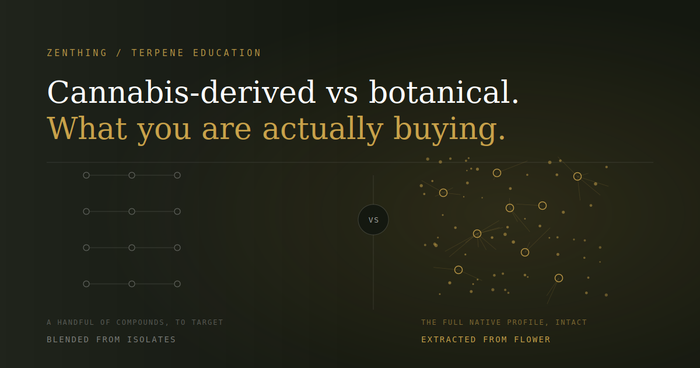
Botanical terpenes are pulled from non-cannabis plants citrus peel, pine resin, lavender, hops then blended in specific ratios to recreate a known strain's smell. The individual molecules are usually chemically identical to what's in cannabis (limonene is limonene no matter where it comes from), but the blend itself is reconstructed, not naturally occurring.
Cannabis-derived terpenes (CDTs) come straight from actual cannabis flower usually pulled off during cannabinoid extraction or a dedicated terpene-capture step. Because they're sourced from the real plant, they carry trace amounts of the full natural profile, including minor terpenes that are too expensive or impractical to isolate and add back into a synthetic blend.
In practice, that creates two real differences:
Depth. A botanical blend is built from a limited palette usually a dozen or so commercially available isolated terpenes. A CDT carries the actual complexity of the source flower, minor constituents and all.
Accuracy. If the goal is recreating one specific cultivar's smell not "a citrus profile" in general, but the actual fingerprint of a real Zkittlez or Garlic Drip phenotype a CDT pulled from that exact flower starts from a much more accurate place than a botanical reconstruction built off an estimated terpene percentage list.
That doesn't make botanical terpenes fake or bad they're a legit, widely-used category, especially when cost or consistent supply matters more than strain-specific accuracy. But if you're an extractor, formulator, or DIY vaper who actually cares about reproducing a real strain's aroma rather than an approximation of it, the difference between the two is basically the difference between a cover song and the original recording.
How Growing, Drying, and Storage Wreck (or Save) a Terpene Profile
Terpene content isn't locked in at harvest. It's actually one of the most fragile parts of the whole plant, and how it's handled afterward matters almost as much as the genetics.
Growing conditions: Light, temperature, humidity, even physical stress from wind or handling all of it affects how much terpene a plant makes and which ones end up dominant. A little environmental stress during flowering can actually intensify aroma, since terpene production is partly a stress response. Too much, though, and the plant's just trying to survive, not build resin.
Harvest timing: Terpenes usually peak right before full cannabinoid maturity, then start degrading. Harvest too early, profile's underdeveloped. Too late, and the lighter, brighter terpenes limonene, pinene, the ones doing the heavy lifting on top notes have already started evaporating off in real time.
Drying: This is where most aroma dies, industrially speaking. Terpenes evaporate at relatively low temps, so fast hot-drying torches way more aroma than a slow, low-temp dry. Same reason fast-dried herbs taste duller than slow, gently-dried ones.
Curing: A proper slow cure sealed containers, periodic burping lets harsh compounds like chlorophyll break down while keeping terpenes mostly intact. Rushed dry-and-go skips that benefit entirely.
Extraction method: When terpenes get pulled for concentrates or CDTs, the method matters a lot. High-heat extraction burns off the lighter, more volatile terpenes first the exact ones responsible for bright citrus and floral notes leaving a final product weighted toward heavier, heat-stable terpenes like caryophyllene and humulene. That's part of why a poorly extracted concentrate can smell flatter or one-note compared to the flower it came from, even with identical or higher potency.
Storage: Light, heat, and oxygen are the three things that ruin a terpene-rich product over time flower, concentrate, isolated CDT, doesn't matter. Terpenes oxidize, and oxidized terpenes don't just smell weaker they can smell different, sometimes in a not-good way (perfumers call this "going off," and it's a well-documented problem). Cool, dark, sealed storage isn't optional if you actually want the profile to smell the same in month three as it did on day one.
Terpene Myths That Need to Die
"More terpenes = better high." Terpene percentage on a COA tells you about aroma intensity, loosely. It's not a reliable stand-in for potency or quality. A flower testing at 1% terpenes can smell incredible if the ratios are right. One testing at 3% can smell flat if it's dominated by one or two terpenes with nothing supporting them.
"Each terpene has one specific effect." The "linalool = relaxing, limonene = energizing" thing you see everywhere is mostly extrapolated from limited research, often using isolated doses that don't reflect how a full product actually works. What terpenes are genuinely well-documented for is aroma and flavor not predictable effects.
"Indica vs. sativa explains the smell." That classification was never about chemistry it's a rough description of plant shape (height, leaf structure) that turned into a loose, often inaccurate effect predictor. Two plants both labeled "indica" can have wildly different terpene fingerprints. If you're shopping or formulating based on smell and experience, terpene profile is just a more useful number than the indica/sativa label ever was.
"Synthetic and botanical terpenes are the same as cannabis-derived ones." An isolated limonene molecule is chemically identical no matter the source. But a blend of a dozen isolated terpenes isn't the same as a profile that occurred naturally in a living plant, surrounded by dozens of minor compounds nobody bothered isolating. The individual molecules match. The full picture usually doesn't.
"Terpenes are just about smell, not taste." Smell and taste are way more connected than people think. Most of what you perceive as "flavor" is actually smell, detected retronasally as you exhale which is exactly why everything tastes bland with a stuffed nose. Food, wine, coffee, cannabis, all the same mechanism.
Frequently Asked Questions
What are terpenes, in plain English?
Aromatic compounds plants make that are responsible for smell and taste. Cannabis, citrus, pine, lavender, hops same chemical family, different specific molecules and ratios.
Are terpenes the same thing as essential oils?
Close, but not quite. Essential oils are complex mixtures that contain terpenes plus other compounds. Terpenes are a major piece of essential oils, not a synonym for them.
Do all cannabis strains have the same terpenes?
No. A lot of strains share the same headline terpenes (myrcene, limonene, caryophyllene, pinene show up constantly), but the ratio between them plus which minor terpenes are floating around is what actually makes each strain smell distinct.
Why does the same strain smell different batch to batch?
Genetics plus environment. Light, temp, humidity, harvest timing, drying, curing any of these can shift the final profile, even with identical genetics from the same grower.
What's the real difference between cannabis-derived and "natural" terpenes?
All CDTs are natural by definition pulled straight from the plant, not synthesized. "Natural terpenes" as a marketing phrase sometimes gets used loosely for botanical (non-cannabis) terpenes that are also naturally sourced, just from a different plant. The real split isn't natural vs. synthetic it's cannabis-derived vs. botanically-reconstructed.
Do terpenes evaporate over time?
Yes, that's basically their whole deal volatile means they evaporate easily, especially with heat or light. Cool, dark, sealed storage is the difference between a profile that holds up and one that fades fast.
Can you actually taste terpenes?
Sort of but most of what registers as "taste" is smell, detected retronasally while you exhale. Same reason food tastes flat with a stuffy nose.
Is a higher terpene percentage automatically better?
Not really. It measures concentration, not balance. A well-balanced lower-percentage profile can smell more complete than a high-percentage one dominated by one or two notes.
Bottom Line
Terpenes are a legit subject of plant biochemistry and also the entire reason a flower in your hand smells like citrus, pine, or fuel. Once you get why they exist (defense, signaling, pollination), the how growing, drying, extraction, storage actually starts to make sense instead of feeling like trivia.
Cannabis is still catching up to how seriously wine, coffee, and perfume treat their own aromatic compounds. As testing gets more accessible and people get better at actually reading a COA, terpene profile is quickly becoming a more useful thing to look at than THC percentage alone.
Want to Smell the Difference for Yourself?
Everything above is the reason the botanical-vs-CDT distinction actually matters in practice. Zenthing sources terpenes directly from real Oregon-grown cannabis flower not reconstructed from isolated botanical terpenes and every batch ships with a published Certificate of Analysis, so you can see exactly what's in it before you buy.
Strains currently available on Zenthing.eu:
- Garlic Drip
- Blue Dream
- Strawberry Diesel
- Zkittlez
- Ice Cream Cake
- Sour Chem
- Super Lemon Haze
- Pear Blossom
- Tropical Tempest
- Guava Biscotti
- Blueberry Muffin
- WiFi OG
- Pineapple Kush
- Pineapple Dayz
Want to experiment with your own blend? Try our terpene mixing calculator.